

How Field Service Management Tools Can Help You Improve First Time Fix Rate


FTFR: The Metric Behind Service Performance
FTFR measures the percentage of jobs your technicians completed on their first visit to reduce repeat visits. It’s a key business metric because it impacts on customer satisfaction, technician productivity, and operational cost-efficiency – not to mention the problems it can create when technicians don’t, or can’t, fix an issue first time.
In this blog, we look at why many service teams struggle with low FTFR, share practical steps you can take to improve first time fix rates, explain how field service management software can help, and the tangible results it can deliver.
What Is First Time Fix Rate and Why It Matters
First-time fix rate (FTFR) is a key metric that many service organisations use to measure performance. It’s calculated by measuring the percentage of jobs that are successfully completed the first time, and therefore, do not need a follow-up visit.
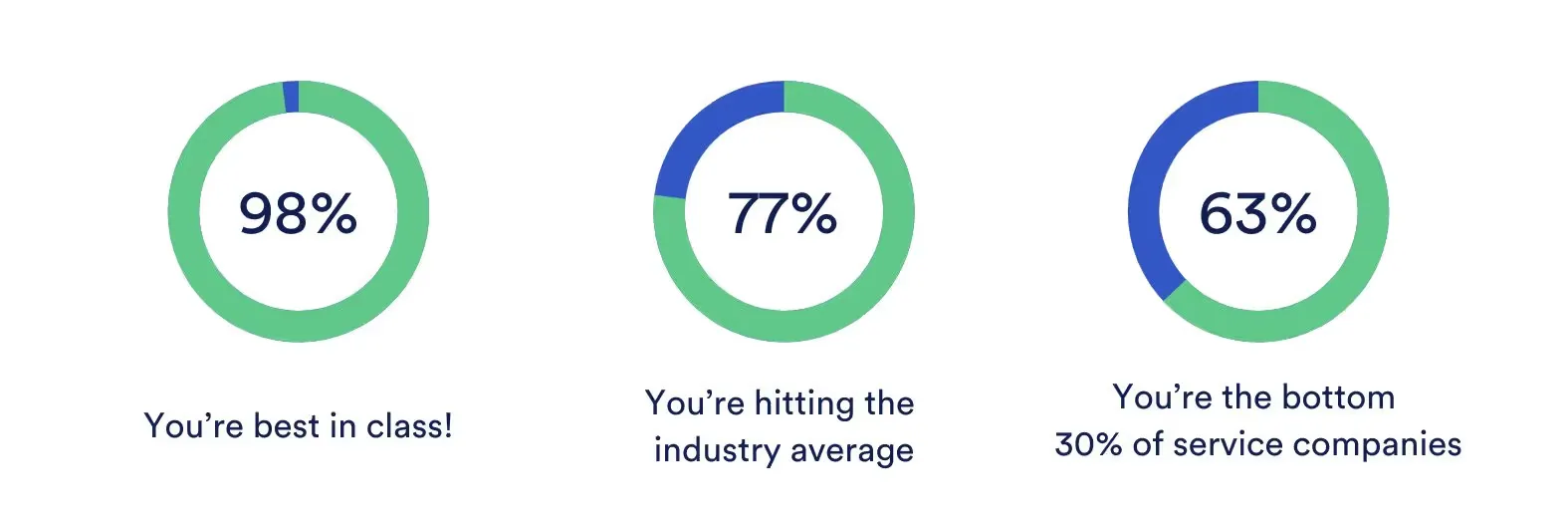
Research found the top 20% of service-related businesses have a FTFR of 88%, with those considered as best in class achieving a FTFR of +98%. Whereas the bottom 30% of companies have a FTFR of 63% or less – demonstrating the link between efficiency and business success.
To calculate your FTFR is really simple. Just divide the total number of jobs fixed on the first visit by the total number of jobs performed, and make it a percentage.

For example:
If you assign 50 technicians to 10 jobs per week each, your company attends 26,000 jobs per year.
At a FTFR of 70%, only 18,200 jobs are completed in the first visit.
If you can improve your FTFR by just 10%, you can complete 2,600 more jobs – increasing the total number of jobs completed first time to 20,800.
Let’s imagine each visit takes an average of 4 hours and technicians are paid £20 per hour.
The additional 2,600 jobs completed first time saves you 4 hours per job in second visits, equal to 10,400 hours per year or a labour cost of £208,000.
If you use just half of the time gained, it means you have an extra 5,200 hours, so you can effectively complete 1,300 more jobs.
And if you charge this out at £400 per job, you can make additional revenue of £520,000.
As you can see, this small increase to the FTFR has a big impact on revenue, and offers other benefits too:
- Customer satisfaction: customers are happier because they’re back up and running quicker, which can result in a 23% premium in terms of share of wallet, profitability, and relationship growth over the average customer.
- Technician productivity: as per our example, by eliminating the need for a second visit, technicians have more time to complete more jobs.
- Cost efficiency: once your FTFR hits 70%+, your operational costs can reduce by 53% due to lower travel expenses, reduced labour costs, and decreased parts waste.
Common Reasons for Low First Time Fix Rates
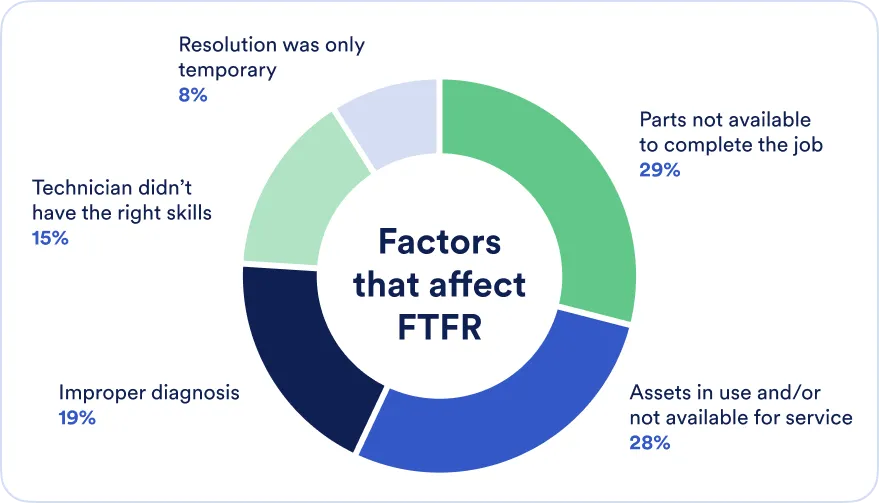
Your first time fix rate (FTFR) can be affected by several factors, including parts unavailability, assets not being available for service, improper diagnosis, and technicians not having the right skills.
- Access issues or unprepared customer sites: despite a job being scheduled, poor communication can mean the asset isn’t onsite when your technician gets there.
- Poor scheduling and dispatching: if you don’t manage your technicians correctly, you end up sending the wrong person with the wrong skills to a job.
- Incomplete or inaccurate job information: your technician doesn’t really know what they’re walking in to, and is unlikely to have the right support documentation to hand.
- Incorrect parts or missing tools: your technician arrives onsite on time, but doesn’t have what they need to fix the issue.
- Limited visibility of stock or asset history: your technicians don’t know which parts to replace due to wear and tear, and can’t order the parts they need onsite.
- Disconnected systems or paper-based processes: one misplaced file or overlooked piece of paper can cause your whole operation to fall down.
How Field Service Management Software Helps Improve First Time Fix Rate
Field service management software helps businesses like yours to manage their technicians onsite to service and repair equipment. The tool captures and maintains an extensive set of constantly changing data, including technician skillset, van stock, parts inventory, locations and routes, customer contract requirements, asset status data, and more – which in turn, helps your technicians fix an asset first time and reduce repeat visits.
The following sections explore how some of the core functionality within field service management (FSM) software can help to improve your first time fix rate (FTFR).
Smarter Scheduling Optimisation and Dispatching
When poor scheduling results in the wrong technician with the wrong skills being sent to a job, FSM software helps to better coordinate your resources. With visibility of your technicians’ skillsets and qualifications, as well as their geographical location and calendar availability, assigning the right person to each job becomes effortless.
At Service Geeni, we’ve taken this one step further with our AI Scheduling Agent to plan smarter, more efficient schedules for your technicians in the field. It allows you to:
- Turn lost time into more jobs completed: smarter route planning results in up to 55% fewer miles travelled per day and 23% less travel time.
- Increase daily job capacity: scheduling optimisation gives your technicians more time to fit in an extra job per day.
- Meet SLAs more reliably: make sure time-sensitive jobs are prioritised and completed on time.
Complete Job Information at Technicians’ Fingertips
When incomplete or inaccurate job information leaves your technicians working blind, FSM software empowers your team with a mobile workforce app. From job details to asset history, support documentation, inventory updates, invoicing, product ordering, and more, your technicians have everything they need in the field to complete the job first time.
Real-Time Inventory and Parts Management
While incorrect parts or missing tools could leave your technicians unequipped to fix the issue, the stock & parts management feature of your FSM software ensures this doesn’t happen. Centralising inventory management across multiple depots gives you full visibility of all your stock. Automated replenishment makes sure the shelves remain full. And on-demand parts availability allows technicians to order what they need in a timely manner.
Seamless Communication and Collaboration
When disconnected systems or paper-based processes lead to poor communication, good FSM software keeps your technicians, back office, and customers connected with real-time updates. Through a dedicated customer portal, everyone can log jobs, track updates, and download service documents, keeping everything running more smoothly.
Performance Tracking and Continuous Improvement
When you want to see how to improve your FTFR, the reporting and analytics offered within FSM software provides all the intelligence you need. With complete visibility into your operations, you can see real-time KPI snapshots to monitor efficiency and make informed decisions to optimise service delivery to drive your business forward.
Practical Steps to Improve First Time Fix Rate
The following are six steps that help to improve first time fix rates (FTFR) simply and effectively:
Step 1: Measure Your Current FTFR Baseline
Without a benchmark you won’t be able to calculate the improvement each change has delivered. To work out your current FTFR, just complete the calculation as above:
Step 2: Identify Common Causes of Repeat Visits
If you don’t already do so, it’s really important to capture the reasons why a technician was unable to complete a first time fix. With this information, it helps you to identify where problem areas exist in your operations, which is the first step to addressing them.
Also, be sure to ask for customer feedback. Post-service surveys, like NPS, are a great way to understand what the customer experience was like. And if a first time fix wasn’t possible, how it impacted their business.
Step 3: Provide Technicians With Training and Digital Tools
Regular training on technical skills, problem-solving, and new equipment will give your technicians more confidence when approaching jobs in the field. While access to information and better communication makes sure they have everything they need to complete the job and improve your FTFR.
Step 4: Review and Optimise Your Scheduling Processes
Field service technicians only spend 25% of their time on engineering tasks. So you want the right technician with the right skills for every job. You also want them there with the right parts, and have allocated sufficient time for them to complete the fix properly. Across multiple field technicians, that’s a lot to organise! Any improvement, however small, can have a massive impact. For example, simply optimising routes by grouping jobs will reduce travel time, fuel costs, and carbon emissions.
Step 5: Use FSM Software to Connect Data, People, and Assets
Yes, we’re biased – but for good reason. FSM software helps your technicians work more productively, which makes your business run more effectively. And because FSM software connects your field technicians with back office functions and your customers, the tool enhances every area of your business. There are many benefits to using FSM software like Service Geeni – some you’d never even think of!
Step 6: Track Progress and Adjust Regularly
Continuous improvement is the name of the game. By working your way through these steps, you can re-calculate your FTFR and compare it against your baseline to see the impact. Then rinse and repeat until you hit the magical number of 90%+.
Results You Can Expect from Improving FTFR
This year, over a third (37%) of service companies are planning to invest in FSM technology – a higher percentage than for CRM, AI, and ERP tools. Like us, they too see the benefits on offer, and want to enhance the way they work to improve first time fix rates (FTFR):
- Higher customer satisfaction: fewer delays and repeat visits create happy customers. Just a 5% increase in customer retention can boost profits by 25-95%.
- Increased technician productivity: a 1% increase in labour productivity can lead to a 1% increase in shareholder value, while engaged employees can boost profits by 21%.
- Lower operational costs: 31% of businesses say their top challenge is driving down operating costs, something an improvement in your FTFR achieves effortlessly
- Better reputation and repeat business: every 1-star rating increase can boost your revenue by 5-9%, as well as create 6.9x more leads for your sales pipeline.
Improving FTFR is Achievable With The Right FSM Tools
Of course, we’re going to recommend Service Geeni! As industry leading field service management software, Service Geeni gives your technicians and office staff access to critical service data, ensures inventory demands are based on planned service visits, and those essential parts are available when needed.
Also, Service Geeni gives remote technicians complete visibility of contract requirements, asset status and job history, outstanding jobs by site, van stock, parts across the network and upcoming scheduled maintenance. All this improves transparency and collaboration between all aspects of your operations.
In short, Service Geeni gives you the tools to make significant improvements in your FTFR, and therefore drive business growth for the future.
Want to learn more about FTFR and how to improve yours? Download our free guide!
Download Full PDF
Read More…




Book Your Demo Today