

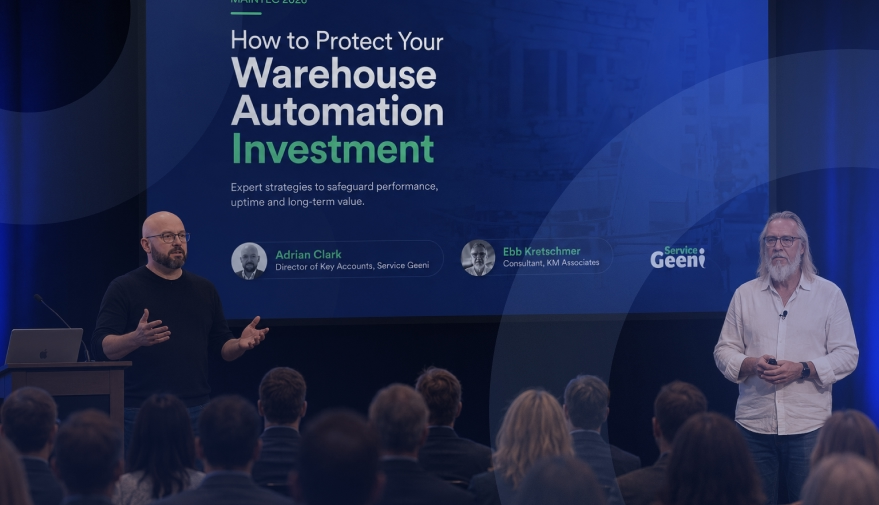
Webinar Recording: How to Protect Your Warehouse Automation Investment

Welcome & Introduction
Adrian (00:00)
Hello everyone welcome to our latest webinar, how to protect your warehouse automation investment, the maintenance mistakes owners don't see. I'm Adrian, I'm delighted to be joined by someone who has spent many years working in and leading global service teams within highly automated warehouses and now supports organisations as an independent consultant, Ebb Kretscher. Kretschmer, welcome Ebb.
Ebb Kretschmer (00:25)
Morning, Adrian. Thank you very much for inviting me to this session. And don't worry about getting my name wrong after 18 years of knowing that it's OK. Hi, Adrian. Well, as you know, thank you very much for such a salivrious entrance to this webinar. I've been hands-on engineering for about 40 years in this automation business and in maintenance. That 40 years experience has given me a very practical view of automation. I've seen brilliant systems underperform because the basics weren't in place and I've seen lots of systems outperform their expectations as well because of the investments that the customer has made and put into it.
Thank you for inviting me here today. I work as an independent, as you have quite rightly said in your introduction. And I'm here to support customers, ensuring they have the right maintenance solutions and avoid the pitfalls that I've experienced when they are setting up maintenance solutions or automation solutions for their sites. Thank
Evolution of Warehouse Automation
Adrian (01:37)
Yeah, and as we've already alluded to, we've known each other for quite some time now, obviously, and worked together ⁓ globally. So that's been a really interesting journey for both of us, I think. So just a quick note, we will be online throughout the session and be able to stay on afterwards and ask any questions during the session if you have any. So just please drop anything in the chat. So, yeah, let's dive in. So.
You've spent decades working inside automated warehouses and from a hands-on engineering through to senior level leadership. When you look at warehouse automation today, what feels most different compared to when you first started?
Ebb Kretschmer (02:18)
I suppose Adrian to answer that kind of briefly without going into too much depth at this time. When I started automation was fundamentally mechanical. It was conveyors, was motors, it was sensors and the digital layer simply supported it. It wasn't something that was the important factor at the time. However, today it's the opposite way round and data and the systems that need data is far greater and it's far tightly integrated and it's far less forgiving. A small lapse in a process, Adrian, if I can give an example, a small lapse in a process discipline that once caused a minor delay can now create huge delays in an automated warehouse. What's changed most is the expectation from our customers of consistency. Modern automation performs brilliantly, when the environment around it is stable. But it punishes drift immediately. Our systems, if you don't get your data and your processes right, the machines get all confused and we're in trouble. The technology has evolved, but the need for discipline structure, maintenance has only increased. it's the cleverer of the more the maintenance requirement is needed and the cleaner processes we need. That's what's changed.
Adrian (03:46)
Yeah, that's really interesting because technology has moved on a lot, hasn't it, over the last sort of, certainly even in the last five, 10 years, my So when major automated systems struggle or fail to deliver their expected value, is it usually a technological problem or is it something else?
Ebb Kretschmer (04:05)
Good question again, if you like, in my experience then, it's rarely the technology that's the problem. The hardware and software are usually very capable. They've been designed and they've grown over the years. As technology has increased, people have become more used to designing and delivering better machines with better technology. So they've learnt from their early days.
The real issues tend to sit around ownership processes, Clarity and organisational alignment, that's where the real issues are. I've seen brand new systems underperform simply because no one defined what good maintenance is.
Or because operations and engineering were working different priorities, automation doesn't fail in isolation, Adrian. If you have an empty building, if you could create an automation system that was self-sufficient and you had the same size shape box going through it all the time and it was running as it had been commissioned and tested. If you don't introduce people into it, if you don't introduce changes into it that automation system will run. It fails when the organisation around it isn't set up to support it properly.
Common Mistakes in Automation
Adrian (05:30)
So in your experience then, what are the most common mistakes automation owners make?
Ebb Kretschmer (05:38)
There's a few standout ones, Adrian. mean, to be honest, there are an awful lot of mistakes that you can make in automation, but the few standout ones, if I was just to kind of highlight three, ⁓ I'd probably say treating maintenance as a cost, not a risk or a control function. Underestimating all of the disciplines that are required in a warehouse solution or just maintenance, your operators, your... ⁓
drivers, anyone, your machine minders, all of them understanding the disciplines that are required. Relying on OEM documentation from the supplier instead of building their own operational standards. In the first place a warehouse has to set themselves up but as they get further and further down the stream they should be disciplining their maintenance to a tighter regime that fits better with their process.
Initially, there's going to be lot of RG bargy operations want to do this. maintenance want to do that. So they're the three standout ones. Spend more time, spend as much time in defining what your after market looks like in a warehouse solution and what your teams are and how they're going to work. As you do in prepping for your
system, i.e. designing your system. I see so many automation people come across the many suppliers I've worked for and they'll spend weeks, months and years talking about the automation, the conveyoring systems, the picking systems, the sortation systems, all of that. And they then kind of like try and crunch the maintenance and the support of that and understanding it into a few months.
Adrian (07:29)
Mmm.
Ebb Kretschmer (07:30)
Balance isn't right. I'm not saying you need to spend years talking to me about maintenance either. You just need to appreciate the process.
Adrian (07:38)
Yeah, and I think that's probably quite difficult in some instances, isn't it? But do owners then underestimate the level of discipline and consistency that's required?
Ebb Kretschmer (07:49)
⁓ I don't think so. The simple answer would be to say yes. ⁓ Automation needs consistency, automation rewards consistency. If you don't be consistent to what you expect it to do, then you will be punished. The system will turn you off basically, you'll have jams and...
But you can get away with shortcuts maybe. Even in the best systems you can try and get away with shortcuts, but it's not possible in today's modern automation systems. You have to follow the logical process.
Importance of Maintenance
Adrian (08:29)
Yeah, that makes a lot of sense. Why do so many organisations treat maintenance then as an operational cost rather than a projection of their investment? Because these systems are very, very expensive. So ensuring they run at peak performance surely has to be important, but it almost seems like it's not taken as seriously.
Ebb Kretschmer (08:51)
I guess because the consequences of poor maintenance, i.e. the consequences of not doing maintenance, are delayed. You can get away. It's a little bit like you, Adrian, driving your car down the road. can forget a service and you can go down the road and you can do another 10,000 miles and be absolutely fine initially. But somewhere along the line, when you're in the middle of Snake Pass in the middle of winter on the way to your mountain biking trip, Adrian, you'll be... broken down and it could potentially be because you didn't do the service at the right time. So you don't feel the pain immediately. think that's part of it as well. The machines are better. They are more reliable.
Adrian (09:33)
Yeah, they're designed to work under more extreme conditions and for longer. But I mean, ultimately what does happen then? What happens long term when the maintenance is consistently deprioritised if people aren't doing it?
Ebb Kretschmer (09:50)
I think the easiest answer to say to that is, one, you don't save any time by delaying that maintenance. You borrow it, that's all. And the interest rate that you've got to pay on borrowing that time by not doing the maintenance, it's brutal. Over time, you'll see more frequent failures, lower throughput, higher reactive costs. A breakdown in trust, I guess, between operations and engineering will happen because operations will complain and moan and groan and maintenance will get all defensive and say, but you didn't, you didn't, we didn't. Eventually the system becomes unpredictable. And once that happens, the operation becomes unpredictable as well.
Challenges and Solutions in Automation
Adrian (10:45)
It is something I hear quite regularly because obviously the warehouse is there to perform a certain task. It's to hold goods, ship them out and get them to the customer as quickly and as smoothly as possible. the, so the, so the operational team want to use that as much as possible. Probably got high, you know, deadlines to hit. ⁓ And yeah, it's clearly it's an outer site out of mind problem, isn't it? If it's not happening.
Is it going to happen? then obviously when that issue occurs, as you say, you tend to put heads with the engineering team and the operational team. So how did you, how did you approach that conversation with operational leaders about planned downtime then?
Ebb Kretschmer (11:24)
Well, if they wanted to listen with operational leaders, if they wanted to listen, if they gave the time to understanding, so it goes back to a question that you asked earlier, if they gave the time to understand the maintenance requirements. I always tried to frame maintenance downtime as protection, not an inconvenience. ⁓ I tried to show leaders the cost of unplanned stoppages versus the controlled cost of planned work. And I made sure downtime was structured. So it wasn't just an ad hoc thing. We didn't just go there and turn up and people knew they understood. But it was predictable and it was respectful of the operation. When operations can trust the process Adrian you'll find that they're far more willing to support it. So they can trust that the downtime is only
couple of hours or is only a couple of minutes, then they're more likely to support it the next time around as well. I would engage and encourage the maintenance management teams on site to engage with senior managers and operation managers on site to plan, plan downtime in advance so that it wasn't seen or felt. And also to advise in those sessions what the risk is by not doing it so that the operations manager can take that to his senior management.
Adrian (12:53)
That's really interesting. So what does good planned downtime look like, certainly from your perspective?
Ebb Kretschmer (13:01)
People probably wouldn't agree with me but good downtime is it has to be clearly scoped it has to be repeatable and it has to be well communicated simple really isn't it talk to each other plan well and deliver the plan. Things are always going to come up Christmas happens every year and it surprises me that every year we have the same arguments about maintenance team saying we're going to block out from October through to January we're going to do no maintenance and just be reactive. Wonderful. In comes that probability of failure again just when you don't want it to. So communicate well planned and deliver. That would be my answer to that what would good downtime look like.
Adrian (13:56)
It certainly sounds like a logical plan and obviously convincing people to do that and putting it across like that. I think you probably have the best effect, wouldn't it? So if we look about issues that might commonly arise, I mean, there's going to be a number of different things, but common issues like operator error, twisted totes, poorly loaded items can sound trivial, but why do they cause such outsized problems in automation? So what's going on there?
Ebb Kretschmer (14:23)
So small issues causing big issues, you mean? Yeah, okay. It's because automation is so integrated, they're so large. If you look at the ones we did in America, four million square meters of warehouse of conveyoring automation just amplifies everything that goes on in a warehouse. It amplifies good behaviour, people who put the products in as they've been trained.
Adrian (14:27)
Yeah.
Ebb Kretschmer (14:53)
And it amplifies bad behaviour, those people that want to take a shortcut and they push a box with their hand through a light guard and suddenly that data is lost and that box can't be found and it ends up down a dump lane somewhere. A twisted tote isn't always the totes problem. It can be a process or a discipline problem. The system is designed around predictability, Adrian, the warehouse and the automation.
is designed around predictability. When inputs become inconsistent, that's when you're going to start having problems and the automation reacts exactly as you would expect it to. You'll say, I don't understand this. What's happened? I've lost this function that way. Where's this meant to go? Whoa, how did this get here? Yes, you do get twisted totes is also the answer. You can get twisted totes. But here I'm going to give you an example of that.
I see so many people packing totes in the past and the good companies have supported training to make sure they pack the totes because the weight balance in a tote on a conveyor or on a piece of machinery is exceedingly important. I've seen totes lift up and raise up like a horse going up inclined conveyors because the weight of the packages they put in the tote are at the back.
Adrian (16:05)
Mm-hmm.
Ebb Kretschmer (16:16)
So maybe they're too light, maybe they're too heavy, and it's the process. Think about the process. As I said earlier on, it's about the process. Make sure you get your processes right and your training right and then consistently deliver that and you'll get rid of those. Why do small issues make big issues?
Adrian (16:38)
It's interesting that because if we, we pull that back into the world of CMMS software and what the engineers using to record that information, you know, if you don't have that granular data, then how do they know where the problem lies or exists and how best to tackle it? So the example that you gave there is probably not the totes fault. It's quite possibly whoever loaded that tote and then, and their lack of understanding on how best to do that efficiently and safely. But if that information is not being disseminated across the organisation, nobody knows, you continue to get that problem and that has an impact on the throughput of the warehouse and ultimately what, you know, the purpose of it being there. So how often did you see repeated failures because the original fault wasn't captured clearly and that information hasn't been shared.
Ebb Kretschmer (17:28)
Oh, in the early days, Adrian, let's say before, ⁓ software tools to record events on and things like that, in the early days it was an awful lot. Constructive criticism sometimes is very hard for some people to take, so I would advise nobody to walk up to an operations manager and say, by the way, you put those totes on wrongly. You haven't packed, stacked, or racked them correctly. you've allowed totes with inferior cardboard and tape hanging off them to go through, I would suggest that that might be a wrong way of approaching ⁓ a nice operations manager. And using a tool that is a trusted tool, which is a maintenance tool like a Simumet and ensuring that our engineers record what they've seen, what they've done, how they've corrected it, and what would be the advisements for the... So don't just finish off with saying... going into CMMS and saying tick, all done, all okay. That to me isn't helpful. We need to make sure that as part of this process, we've trained our technicians to give root cause analysis so that we can provide a detailed report by our site manager or our team leaders in those daily operation meetings and said, this is what we found yesterday. This is what happened. And here's our reporting from it. And here we give that to you because
Maybe when you're doing your refresher training with people, you can make sure that they eradicate these problems or refine. So have a good piece of software that can record, have engineers that are trained to use it properly and manage that they do use it properly.
Adrian (19:11)
There's a couple of key things that you mentioned there actually. And one of them was root cause. And it is critical, isn't it? I think to enable the engineering team to capture that level of detail as to not only what went wrong, but maybe what category it was or why it went wrong and ensuring that you have that granular information. So you can actually get to the root cause of where the issue is happening. mean, can be anything from training to substandard products like cardboard or glue to shut the boxes or a labeling machine or anything of that. So, I mean, the important question there is what happens when a fault data does lack that detail or that structure?
Ebb Kretschmer (20:01)
What happens is you just end up going back to the same problem time and time again. And ⁓ patterns don't just disappear. Root cause becomes guesswork. ⁓ Maintenance becomes reactive. And any hope of being predictive has disappeared. You've really, Adrian, I mean I know it's difficult for some teams and for some operations to get their head around it.
but without proper data, without proper root cause, you can't improve. Look, we could have a personal problem. We could have a shift problem. It could be one shift that always you have the failures in, but when the general manager sees his report at the end of a month or the end of a week or busy week that he's been in, he just sees a lump that says these machines weren't working, no granularity in it. So he needs us to have the report and he needs to be able to use the software systems, that our automation companies provide them to run those reports, those SCADA solutions, those SCADA reports. And those reports then, if you're running a good warehouse, you work with your maintenance team, you work with your operational team, you work with your transport team, and you listen to what you can do, you correct what you can do, and other items might take longer. Communication mate.
Role of AI in Maintenance
Adrian (21:25)
Yeah. And again, you said a number of things that it's brought my interest data, for example. ⁓ there's a hell of a lot of data that's captured now by teams on site. So we are very well, we've been in the era. think of big data, which is essentially as significant amounts of data points for quite some time now. And we've moved now into the era of AI because the human brain, can't really look at that huge data set, rationalise it and organise it and do something tangible with it. ⁓ And AI is now helping us achieve that. What's the bigger picture? Where are the fault trends? Where are the throughput trends? Where do we need to apply resource? So there's a lot to do. mean, even at Service Geeni we already got a number of AI tools that we use internally to help make our working day efficient across the entire business from commercial customer success and even development, you know, but that's now already in our in our software and plans to do more. So it is a crucial part of what we're going to be doing in the future. But what do you think is going to be genuine, genuinely valuable? And what do you think is going to be hype in the world of AI?
Ebb Kretschmer (22:39)
Ooh, big question. Predictability. mean, AI can be good with predictability. Let's kind of set the floor plan for AI, shall we? At this moment of time, there's a lot of data and it's all being provided by a lot of automation companies to their end users in different ways. Because let's say one company with their solution do it one way, another company.
Do it another way and I have experience of that because I've worked in so many of these companies everybody has their own language everybody has their own IP requirements and things like that and their intellectual property requirements for AI to be this super tool
If I take it from the small consequence of one warehouse with 400,000 assets sitting in it, then we need to make sure that we're reporting ⁓ correctly and in the same manner by everyone using the same example of wordage for an event or a failure or an occupational health and safety issue or whatever it is. Reporting is key and AI
at the moment is learning. So at the moment with AI, it should be getting to predictability and it should be getting to early ⁓ anomaly detection that can say, you've had this fault before, you had it last week without an engineer having to go into his software and look for that event, it should be coming to him. It says, ah!
By the way, you've been called out to this fault. This is what happened last week. These are the things that went...
Adrian (24:31)
Yeah, we've got this type of problem four times, this type of problem three times. These are the typical types of fixes and these are the parts that you might need to fix it. Exactly what exactly what we're working on at the minute bizarrely.
Ebb Kretschmer (24:39)
Exactly. Exactly.
So, helping the teams on site to be better, think AI can do that. And if you're using AI in your solutions, then absolutely. the other vehicle with that is to make sure that those people that using your solutions put the information in a standard manner, that they put the right information in the right place. Right information in the wrong place, wrong answer. Hype, is there any hype in AI?
Adrian (25:00)
Yeah, completely.
Ebb Kretschmer (25:11)
Well, I guess a lot of people are talking about, AI will replace technicians. No, it won't. No, it won't Adrian. Not in the first place anyway. It might make their jobs easier though, and far more rewarding. And here we go, something that you say and borrowed from me many moons ago. First time, right, right place, right time, right tools and the right parts. That and.
Adrian (25:35)
It's mantra that I learned from you, Ebb and I recite quite regularly when I'm in meetings with other customers.
Ebb Kretschmer (25:43)
Absolutely. AI can fix poor processes. No, it can't. If your processes are poor, it will keep you poor. Bad data in, bad information out, good data in, good information out. And then it may be, then maybe we might be able to have a far more efficient team on site. So replacing technicians, no. But what it might do, it might release technicians from doing their maintenance work into being more proactive maintenance tasks in condition based monitoring maintenance tasks.
Adrian (26:21)
Yeah, I completely agree. So before then, AI can add real value. What foundations need to be in place in terms of data quality, process discipline, team behaviour, that sort of thing.
Ebb Kretschmer (26:32)
You just answered it Adrian, do I need to repeat it? Three things. Clean structured data. Consistent fault logging. Stable processes and behaviours. AI is only as good as the environment it's dropped into. It can't do it on its own. It needs food and the food is the information we put to it and then it's the combination of that data that comes back out. How many times do you see people today answering emails by using AI?
Adrian (27:10)
Me, definitely. Very regularly.
Ebb Kretschmer (27:10)
Yeah, I try not to, but sometimes my emails can be quite obtuse. So sometimes I kind of like just drop it in there and it's quite good because many people have been doing that for a long time and it's getting better at it. So for goodness sake, give AI a chance in the automation world to catch up and it will for sure it will. You're already using it. So you must be seeing benefits from it.
Adrian (27:24)
Yeah.
Yeah, a hundred percent. mean, the one example you just gave there is emails. You know, depending on the situation, you want to be able to either make that because I can waffle on with the best of them. So I want to, I want to make it the email more concise. I want to make it more to the point, or maybe you want to strike a certain tone. And it is really good at doing that, but it's also good at doing analytic work. And the plans from our perspective, it's a, they, I embrace things like.
What parts should we have available? When should we be ordering parts? Where should those parts be to be more effective based on the profile of equipment in a certain area of a warehouse, for example? You know, have a stock holding of certain parts at one end because there's more automation equipment over in that area, whereas there's maybe more ⁓ manual processes in a different area. So, you know, how best to achieve that or even helping the engineers understand, as we mentioned earlier.
What are the common problems that you've had with this piece of equipment and what's the potential best fit for it? I mean, there's a lot of things that we're looking at, but where do you realistically think AI is going to help maintenance teams in the next few years?
Ebb Kretschmer (28:45)
For well, I I'm out of the game now. But for me, think AI will help most with ⁓ prioritising work for maintenance teams. I guess because we also use AI in the automation world to help us with our design and everything else like that, it'll help suppliers of automation to choose the right machine for the right task, maybe.
in the future. So, but let's stick to maintenance and not go down the big world. Prioritising work, Adrian, is a standard that I'd expect it would be able to do. Identifying repeat faults, IE, it knows and it sees from the data that we put in what our problems have been. And it can advise us of, by the way, you seem to be having this problem every week, and it's on this shift, and it's on this time and it's on this transport load or whatever it is that goes through the conveyoring system. So it should be able to do that. It should be able to predict wear patterns as well. When did we change something? What part did we fit? Is that part consistently been a failure? Do we need to start looking at that part? It should be able to be more predictive for us and predicting wear patterns and telling us clearly.
Adrian (29:55)
Mm-hmm.
Ebb Kretschmer (30:11)
Even though within your system you do have a very good stock management solution to tell us where that part is. by the way, Mr. Technician, don't bother going walking all the way up the other end of the warehouse to get your part. It's just over there. Hence, transporting time of technicians, travel time of technicians, speed of response, speed of fix is attached to that. So AI could be quite good in doing all of that. Where I see if people are going to use AI properly, Adrian today we have a labour problem. We have the inability to find the right people with the right skills to come in and do the right job. Population isn't having as many children's that used to do in the but in my time, you know, I was I was a baby boomer, you could tell I still booming today. ⁓ But we don't have the pick of skills anymore. And because there's so many automation providers and so many automation warehouses, the skill sets become less and less and the salaries are going up and up. So we need to do something. We need to train people, we need to take people that have got lesser skills. But sometimes that training can take 16 to 18 weeks just for basic training. And if I'm looking to take apprentices into the business, which I hope people do take apprentices in and bring them through, and let them go through the whole kind of food chain of maintenance and become site managers of the future. Then AI, AI is that tool that can support less experienced technicians, that can train less experienced technicians, that can be used in the training portfolio. Yes, we've got to put an infrastructure in these large warehouses. If you've got 400,000 assets sitting in a warehouse, I'd expect to see the trainings. Room in there training skill room in there of which AI could be part of that training skill room giving them the experienced information about faults and failures allowing the technicians to fix it and report back down so I can see AI, AI as I said before it won't replace people or the workload well not yet anyway but it would make good teams even better.
Adrian (32:37)
Yeah, completely agree with all of that, to be fair. mean, you, so AI has got to leverage data, which has got to go into a system. So when you're advising automation owners today, how do you put it across them? What, what should they be expecting from a service management or CMMS platform to ensure that they can protect their investment? Because again, the system ultimately, can mean the success and failure of the team that are protecting that multi-million pound investment in equipment.
Ebb Kretschmer (33:08)
Yeah, OK, good question. What should you expect from a CMMS to work would be a good thing. They should expect simplicity, not complexity. A good CMMS should make fault capture easier. Provide a clear asset hierarchy. It should automate reporting and planning.
It should integrate with the operations. Now, I don't mean physically integrate, but it should be able to be integrated with operation workloads as well as maintenance workloads. And that's more being driven then by the user on site, the maintenance team on site to make sure they put the right windows of maintenance together.
Reinforced discipline. I'd expect it to do that. kind of like validation. Saying okay is not an answer. Please do this or whatever. ⁓ Pick from the checklist.
It shouldn't be admin heavy for a user to use. And the system should quietly enable good business procedures, good behaviour. And to support that, Adrian, people who provide CMMS need to make sure there is a network on site that is capable of being interfaced with, so that reporting at the right time. Because if we cannot report on the tools that we've got, I've seen it over the last 30 years, 20-30 years. I'm not going to use this tool because it wastes 15 minutes of my life trying to report. And then it asks me when I get back up to the workshop to report anyway. rely.
Adrian (35:01)
You're absolutely right.
That's a consistent thing that I've seen working with lot of warehouses over the years is there's an investment in the equipment, even the tools and the clothes that engineers might wear. They throw the kitchen sink at an automated warehouse. But what they never do or rarely do is provide a really robust, comprehensive Wi-Fi signal around that warehouse for tools to work as effectively as possible.
It's a common, oversight, if you like, because they don't, guess they don't, again, coming back to what they do when they don't know, they don't appreciate the fact that that's going to be pivotal to being able to have communication across the site. And it's, it's full of equipment. It's full of, it's a big Faraday cage. It's got lots of dead spots everywhere, hasn't it? And it's a, it's a common mistake. Sorry, wrong.
Ebb Kretschmer (35:55)
Absolutely, absolutely.
Yes, it is. also, you know, people need to get over themselves on the basis that the tools are there to make their job easier. I appreciate it's difficult in the first place, but ultimately you can get better with it. You can. You're not going to have the most fantastic network in all warehouses from day one, but over a period of time you will. You need to have multiple processes at the time. But ultimately you do have engineering manager for maintenance. Ultimately, you do have maybe an engineering supervisor, if not a manager on site. Ultimately, you will have team leaders and team leaders aren't ever calculated as being 100 % productive. They're calculated around being 60 % productive because we know there's this admin function and it's their function to make sure that the technicians to police the system.
Adrian (36:47)
Yeah.
Ebb Kretschmer (36:52)
So if you've got a weak network, okay, there's not much we can do about that. However, go back to the first question. If you spent as much time negotiating with the maintenance provider as you did for the system itself, then maybe you would put the right networks in or you would allow them to share the networks because the customer has a network. no, you're not getting on my network. Don't want your data on mine. And then.
Adrian (37:19)
Haha 100%.
Ebb Kretschmer (37:21)
And the automation provider goes, well, you're not going on my network. I don't want you kind of causing problems on there. And then we can't move. So for goodness sake, get a life everyone and come together.
Adrian (37:30)
Yeah, needs to be something that needs to be hashed out and from my perspective, that's definitely a mistake that warehouse owners have. I mean, on that topic, if there's one mistake you think owners should stop immediately, what would that be? What is that?
Ebb Kretschmer (37:49)
If I was to say, if there's one mistake I want an owner to stop immediately, there's one from my personal viewpoint. Stop treating maintenance as optional. Truly understand the cost of not investing in maintenance properly and you'll find that maintenance is the only thing that's protecting your investment. Your throughput and your customer promise.
So treat maintenance as a strategic part of your business, work with maintenance as a strategic part of your business. I understand you want to get value and negotiate the prices you think you're being charged extremely for, but rest assured, whether the automation company provides that maintenance or third party company provides that maintenance, the costs you're going to get would be exactly the same costs if you did it yourself customers out there in the world. So embrace it. Work with the team. Define your future. Improve the maintenance requirement. Make it more efficient. You will then make those savings. But if you come on that journey, if you go on that journey, you'll find that you will improve your warehouse solutions. Many warehouse owners today have spent time working with their maintenance providers and have good maintenance operational solutions working together, delivering together. Look at Amazon, look at other customers, John Lewis maybe and the rest of them. Look at those warehouses, look at Walmart, look at those warehouses. There's a lot of this in the early days, but if they work together and if they consider each other and where they come from, then the motorway is clear.
Adrian (39:39)
Hmm.
Ebb Kretschmer (39:47)
but path is clear.
Final Thoughts and Advice
Adrian (39:49)
Sage advice, sage advice indeed. So now you're in consultancy, what type of organisations are you excited to help on that journey?
Ebb Kretschmer (39:57)
Those that can afford me, Adrian! Those that can afford me. No, it's not that. In the status that I'm in at the moment, I'm excited to help people. I'm working with a few people at the moment just to help them understand exactly what this webinar is about, but in a different kind of question as such. How do I make this maintenance work for my customer? How do I show him the value added of a maintenance solution from myself. So I'm excited to help organisations who know that their automation that they provide or that they've got can deliver more. They just need clarity, structure, and somebody who's lived the reality. Many people I've spoken to in the last five, six months said, my God, I didn't realise all of that was involved in setting up a maintenance solution, a total maintenance solution that provides this level of support, provides this. He said, I just thought I'd provide 20 people, give them a little bit of training and you don't actually do that. And away we go. Everything's fine. But this is a whole business. Absolutely. So whether it's maintenance strategy that a customer wants, or ⁓ documentation training, documentation, excuse me, or training or operational alignment, i.e. how does he get his teams to talk. So I enjoy doing that. I enjoy talking to people like yourself about maintenance as well and sharing the experience, changing the viewpoint that maintenance is a cost ⁓ into a strategic advantage.
Adrian (41:54)
It's gonna save them money because if the warehouse is down, that's going to cost them who knows what every hour that it's not operating. So there's any sort of last words you'd like, because we were drawing to the end of the webinar.
Ebb Kretschmer (42:06)
Yeah, I guess for me, Adrian, I can break it down into two last words. Make sure you have the right maintenance solution. Make sure you invest in the right tools and the right software to run and manage your maintenance. And make sure that you support the teams on site with adequate training and competency training. It's not a one-off shop. This whole thing is... a live experience for many years. Further down the road, I've got warehouses that I was involved with that still running today with maintenance solutions, 30, 35 years still in the process. So I know it works. We, in the maintenance world, need to come with our operational teams together in our warehouses and work together for the product. At the end of the day, we're there to put that iPhone 7 or 17 whatever it is now in your hands for the next day. That's our target as well as it is the operations target. How we get there are just two different ways. So I'd leave you with this, automation doesn't fail because the technology is weak. That's not right. It fails when the organisation around it the operational maintenance isn't aligned.
Maintenance, once again, it's not a cost. It's a mechanism that protects that automation. And for organisations who want to strengthen that foundation, that is exactly what I work for now. And I support that through my self-employed business, KMA, helping teams build clarity and discipline and structure and reliable automation solutions.
Adrian (44:01)
Thank you very much Ebb. It's been a pleasure talking to you today. Absolutely. that wraps things up for today. So thanks again, Ebb, for joining us and sharing your experiences. It's been really, really valuable. And just a quick note again, we'll both be online to answer any questions, so please drop anything into the chat. So thanks very much for joining us today and Ebb, thank you very much for being our guest.
Ebb Kretschmer (44:03)
Thank you, bye.
Adrian, thank you. And thanks, Service Geeni And thanks for all the years that you've been working with us as well. Appreciate it. Thank you.
Adrian (44:32)
Most welcome. It's been our pleasure.
Download Full PDF
Read More…

Book Your Demo Today