

Managing Complex Equipment Sales: Why Spreadsheets Fall Short


What makes an equipment sale complex
Not every equipment sale needs careful coordination. A straightforward, one-off purchase with nothing else attached is usually simple enough to process without much thought.
Complexity creeps in when a deal includes any combination of the following:
- A trade-in that needs valuing and tracking. The value has to be agreed, recorded against the deal, and then reflected correctly once the sale goes through, rather than sitting as a separate note somewhere.
- Spare parts bundled into the sale. These need to be added to the order without getting lost among the equipment items themselves.
- A service or maintenance contract alongside the equipment. This ties the deal to ongoing work that has to be picked up correctly once the sale completes.
- An installation, customisation or delivery job that has to happen before the sale is complete. Someone has to know what's been sold in order to carry the job out, and when it's due.
- Payment split across a deposit, one or more interim invoices and a final balance. Each stage needs to be scheduled, invoiced and reconciled against what's actually been paid.
Individually, none of these are hard to manage. Together, across several deals running at once, they're easy to lose track of. A deal with a trade-in and a service contract needs different handling to a straightforward cash sale, but in most spreadsheets, both end up recorded the same way, on the same tab, with no structure to separate what needs following up from what's already settled.
Where spreadsheets break down
Spreadsheets aren't built for this kind of interdependency. Each tab or file tends to hold one piece of the picture, which means someone has to manually keep the equipment details, the job status and the invoice schedule in sync as the deal moves forward.
That manual step is where problems creep in. A study published in Frontiers of Computer Science found that 94% of spreadsheets used in business decision-making contain errors, with risks ranging from financial losses to operational mistakes. Equipment sales aren't immune to this. A trade-in value that doesn't get updated, a job that never gets created, or an invoice that's raised against the wrong balance can all trace back to a spreadsheet that quietly fell out of date.
Three problems tend to come up again and again:
- Disconnected data. Equipment details, trade-in values and spare parts often live in one file, while jobs and invoicing sit somewhere else entirely.
- No link between the sale and the work that follows. If an installation or service job isn't tracked against the original deal, it's easy for the service team to miss what needs doing, or for which equipment.
- Payment schedules that are hard to follow. Once a deal has a deposit, interim invoices and a final balance, tracking what's been paid and what's outstanding by hand becomes a real drag on finance's time.
It's easy to see how this plays out in practice. A sales rep agrees a trade-in value and notes it in a quote document. The deal also includes an installation job, so an email gets sent to the service team asking them to schedule it. A deposit is invoiced, then a few weeks later an interim invoice follows, tracked in a separate finance spreadsheet. By the time the final balance is due, three different people are holding three different pieces of the same deal, and none of them has the full picture without asking around first.
The knock-on cost of getting it wrong
None of these issues are dramatic on their own, but they add up. A missed installation task means a delayed handover to the customer. An invoice schedule that isn't tracked properly leads to cash flow that's harder to predict. And without a clear view of costs against each deal, it's difficult to know which sales are actually profitable until well after they've closed.
The cost isn't only lost time. Manual invoice handling in particular carries a well-documented price tag. Research from Gartner puts the average cost of processing a single invoice manually in the UK at £4 to £25, rising as high as £50 for more complex or error-prone cases. A deal with a deposit, an interim invoice and a final balance means that cost is paid three times over, before any errors even come into it.
For businesses selling equipment regularly, that lack of visibility becomes a genuine constraint on growth, not just an admin headache.
How businesses usually try to work around it
Most teams don't set out to manage equipment sales this way, it's usually something that builds up over time. A spreadsheet gets created to track one particularly complicated deal, and it becomes the template for the next one. More tabs get added as new requirements come up: one for trade-ins, one for spares, one for the invoice schedule. Eventually, a second spreadsheet appears to track jobs, because the first one was getting too crowded.
Some businesses add a shared inbox or a messaging channel to plug the gaps, so the service team has somewhere to flag questions about a deal. Others rely on one or two people who've simply learned to hold the details in their heads, which works fine until they're on leave or move on. None of these fixes address the underlying issue: the sale, the service work and the invoicing are still three separate things being manually stitched together, rather than one connected record.
What a connected process looks like instead
The fix isn't more spreadsheets or a second system bolted on for equipment sales specifically. It's keeping the whole deal, equipment, trade-ins, spares, service contracts, linked jobs and invoicing, in one place, connected to the systems your sales, service and finance teams already use.
That's the gap our Equipment Sales module was built to close within Service Geeni. Rather than treating the sale as separate from the service work and invoicing that follow, everything sits against a single deal record from quote to completion.
How Service Geeni handles this with Equipment Sales
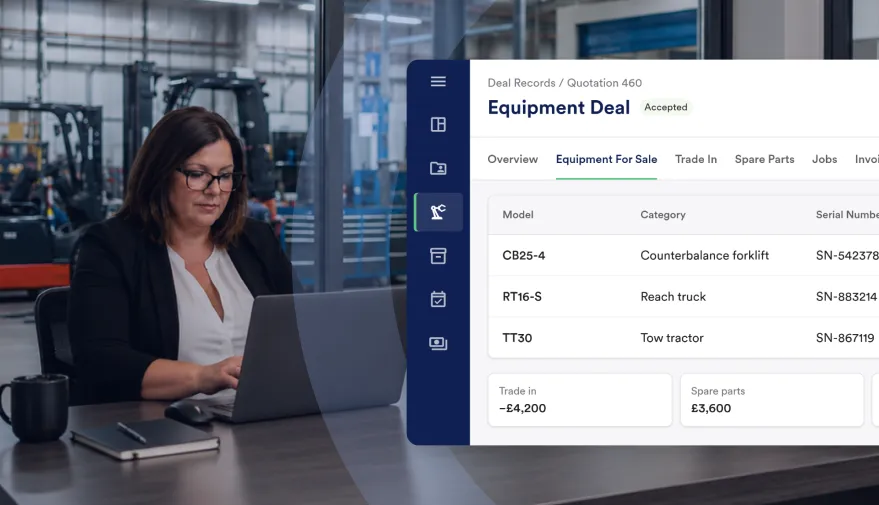
Equipment Sales within Service Geeni brings equipment items, trade-in values, spare parts and service contracts into one workspace. Installation, customisation and service jobs can be created directly from the deal and stay linked to it, so the service team always knows what's been sold and what needs to happen next. Deposits, interim invoices and final balances are scheduled with running balances tracked automatically.
If your team is currently managing equipment sales across spreadsheets or disconnected systems, it's worth seeing what a connected process actually looks like. Take a look at how Equipment Sales works and what it covers.
Contact us to find out how Equipment Sales can fit into your sales process.
Download Full PDF
Read More…
.webp)


Book Your Demo Today