
.svg)
F-Gas and Refrigerant Tracking Software
Cylinder records in one spreadsheet. Leak check dates in a diary. Refrigerant quantities that only reconcile if nobody has been off sick. Service Geeni is F-Gas software that captures every transaction at the point of work, recorded against the system it relates to rather than filed separately and pieced together later.
The #1 choice for thousands of industry leaders


.avif)

.avif)
.avif)
.avif)
.avif)
.avif)






.webp)
.webp)




What the F-Gas Module Does
Track Every Cylinder Through Your Operation
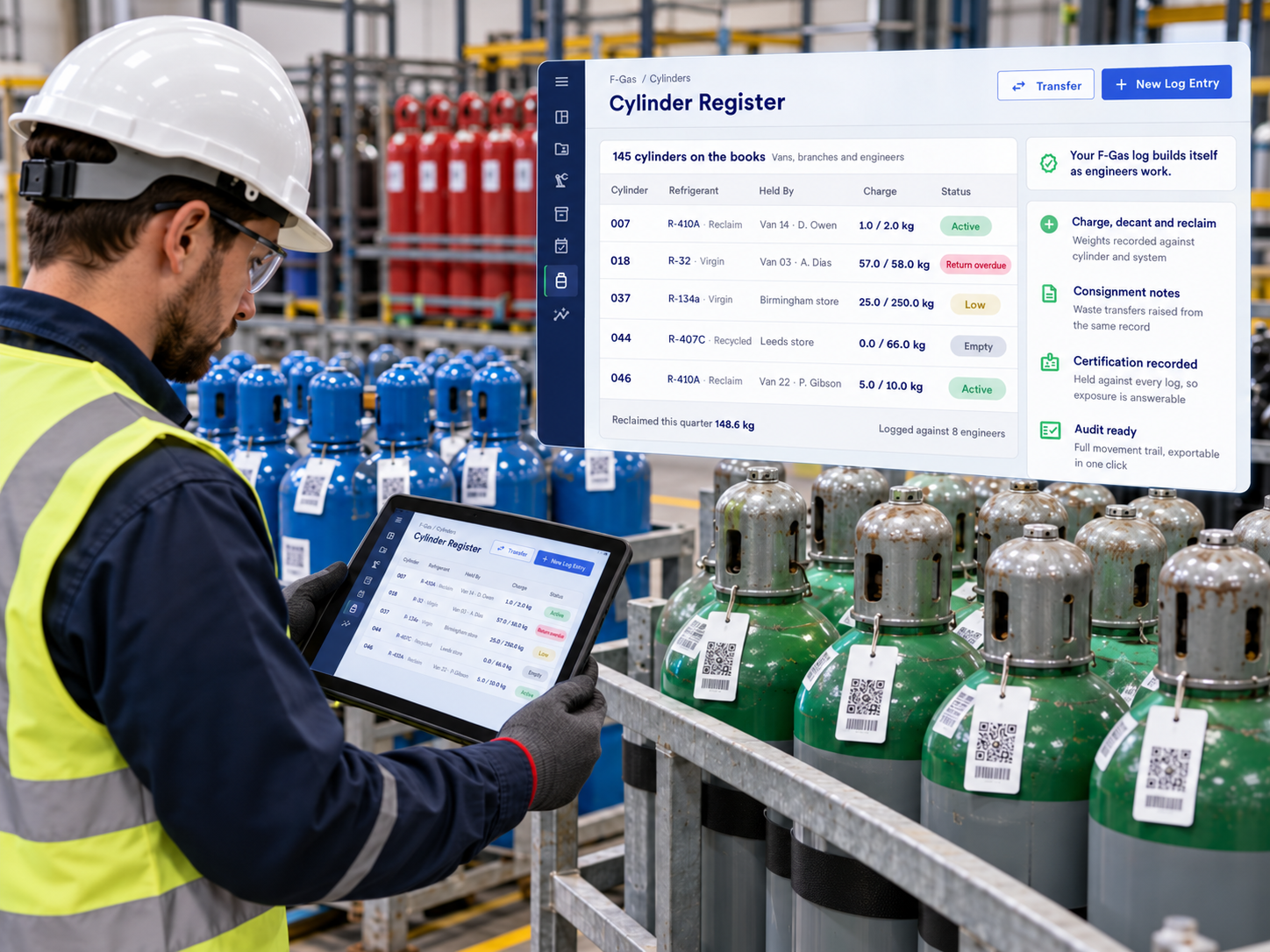
Cylinder records go wrong in the gap between the store and the van. Service Geeni keeps stock, location and usage in one place.
- Hold a cylinder library covering the gas types and sizes you carry
- Track cylinder stock and movements, including which engineer is holding what
- See how much of each cylinder has gone where, tied to the jobs that used it
- Keep cylinder records in the same system as the work, so quantities reconcile against the transactions behind them

Record Refrigerant and Leak Checks Against the System
A leak check that cannot be tied to a specific system is a record, not evidence. Every F-Gas transaction in Service Geeni lands on the asset it relates to.
- Log refrigerant added, recovered and reclaimed at the point of work
- Record leak check results against the individual system rather than the site
- Capture gas type, quantity, cylinder and engineer on every transaction
- Tie the whole record back to the job that generated it
Build an F-Gas Logbook as the Work Happens
An asset's F-Gas history should exist without anyone compiling it. In Service Geeni it builds from the records engineers are already completing.
- Give every system a continuous F-Gas history covering transactions and leak checks
- See what was found, what was done about it and who carried out the work
- Keep F-Gas records alongside the full service and breakdown history for that asset
- Spot systems that keep needing topping up, from the record rather than from memory


Give Engineers F-Gas Forms on the Mobile App
Records completed later are records completed from memory. F-Gas forms sit on a dedicated engineer screen, finished before anyone leaves the site.
- Complete F-Gas forms on their own screen, separate from general job sheets
- Handle cylinder transactions on the mobile app rather than on paper
- Capture customer sign-off at the point the work is signed off
- Send the record straight to the asset, with no re-keying back at the office
Produce Audit Reports Without Rebuilding Them
Reporting should be an export rather than a project. The reports come out of records your engineers have already entered.
- Produce cylinder, transaction and leak-check reports from live data
- Report site CO2 tonnage across your client base
- Pull the figures without chasing paperwork or reconciling spreadsheets
- Hand an auditor the same records your engineers entered, unaltered

Built for the Demands of HVAC
Why Service Geeni for F-Gas Tracking
F-Gas record keeping rarely fails because somebody was careless. It fails because the record lives apart from the work. An engineer completes a leak check on site, the paperwork comes back to the office days later, and somebody types it into a system that has no idea which unit it belongs to. The record exists. Proving it belongs to a specific system on a specific site takes an afternoon.
Service Geeni removes the gap. Refrigerant added and recovered, cylinder movements and leak checks are captured by the engineer as the work happens, against the asset record for that system. Nothing is re-keyed, and nothing depends on one person remembering what was done in March.
The module is live with customers today across commercial air conditioning and air compressor businesses. The back office gets its own F-Gas area, and engineers get their own screens for handling cylinders and completing forms, so each side of the operation sees what it needs without wading through the other.




We’re With You Every Step of the Way
Switching service software can feel daunting, but you’re not on your own. With a dedicated implementation team, customer success representatives, and a knowledge base full of how-to guides and videos, you’ll always have the support you need.
.avif)
.png)
.png)
.png)
.png)
.svg)
Fgas Software Questions, Answered
What is fgas software?
F-Gas software, written variously as fgas, F gas or F-Gas software, records refrigerant handling, cylinder movements and leak checks in one system so a contractor can evidence compliance without rebuilding it from paper. The distinction that matters is where those records sit. Software that stores them as documents gives you a filing cabinet. Software that stores them against the asset gives you evidence tied to a specific system on a specific site, which is what an audit asks for.
What does Service Geeni's F-Gas module cover?
It covers refrigerant added, recovered and reclaimed, cylinder stock and movements, leak check records against individual systems, cylinder, transaction and leak-check reporting, and site CO2 tonnage. The back office has a dedicated F-Gas area, and engineers get separate screens for cylinder handling and F-Gas forms so records are completed on site. The module is live with customers today across commercial air conditioning and air compressor businesses.
How does the f gas tracking work?
Every transaction records the gas type, the quantity, the cylinder it came from, the engineer who carried out the work and the system it went into or came out of. Because the transaction lands on the asset record rather than on a job number alone, the history for any given system can be produced without cross-referencing anything.
How are refrigerant cylinders tracked?
Cylinder stock and movements are tracked through the system, including which engineer is holding what. Since refrigerant added and recovered is logged against the system it came from or went into, cylinder quantities reconcile against the work carried out rather than being counted separately at the end of a period.
What reports can Service Geeni produce for an F-Gas audit?
Cylinder, transaction and leak-check reports are produced from records engineers have already completed, so reporting is an export rather than a data-gathering exercise. Site CO2 tonnage is reported across your client base from the same data. The records cover what the F-Gas Regulation requires you to keep, whether they are being produced for the Environment Agency or for an audit by your certification body, whichever of the three approved bodies you are registered with.
Does this work for commercial refrigeration as well as air conditioning?
Yes. Commercial refrigeration falls under the same regime and is handled the same way, covering cold rooms, food retail refrigeration and commercial kitchen equipment alongside air conditioning, VRF and chillers. If you are weighing up the wider operation rather than compliance alone, our HVAC service management software page covers scheduling, asset history and maintenance contracts.
What should I look for when comparing fgas software?
Three things separate the options. Where records are stored, since compliance evidence tied to an individual system is worth more than documents filed against a site. Whether engineers can complete records on site, because anything captured later is captured from memory. And whether reporting comes out of live data or has to be assembled.
Do our engineers need to work differently?
Not substantially. F-Gas forms and cylinder transactions are completed in the mobile app as part of finishing the job, rather than on a separate paper record afterwards. For most operations that removes a step rather than adding one, because the information stops being entered twice.

Book Your Demo Today