
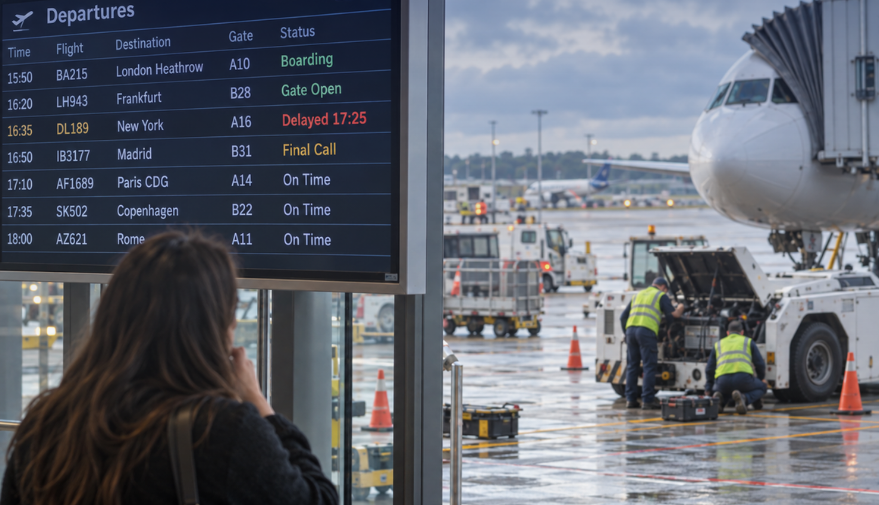
The Most Common Causes of GSE Downtime Across Airport Terminals


What causes most GSE downtime?
The largest share of lost GSE availability comes from coordination rather than component failure. The recurring causes are:
- Assets that cannot be located
- Faults reported verbally and lost before they reach the workshop
- Work orders recorded inconsistently, so history is unusable
- Parts that are not where the job is
- No qualified engineer available at the point of failure
- Each terminal running its own version of the process
- Performance data arriving too late to act on
The repair itself is usually the shortest part of the timeline.
1. Nobody knows where the equipment is
Equipment moves all day. A belt loader used on stand 12 at 06:00 can be on the other side of the airfield by lunchtime, borrowed by another team and parked somewhere nobody logged.
What it costs. Engineers spend productive hours searching, which shows up as slow response times without anyone being slow. Supervisors also make availability decisions on stale information, committing equipment they believe is serviceable.
What helps. An asset register that records location alongside serial number and service status, updated when jobs are closed rather than by a periodic walk round. Larger fleets get further with telematics or tags, but the register has to come first, because location data attached to an incomplete asset list solves nothing.
2. Faults reported verbally, and lost
An operator notices a hydraulic weep at 06:00, mentions it to a colleague, and the colleague goes off shift. No job is raised. The hose fails three weeks later during a first wave departure and it looks like a sudden failure.
What it costs. Twice. You lose the early, cheap intervention, and you lose the fault history that would have shown the pattern across the fleet.
What helps. Digital pre-use checks, so a defect raised on a device becomes a job automatically and flags the asset without anyone making a phone call. The HSE's guidance on inspection, maintenance and repair of workplace vehicles expects drivers to check items such as tyres, lights and indicators at the start of every shift, and recommends giving them a list to sign off. Doing that on paper satisfies the duty. Doing it digitally also gets the defect to the workshop.
Handover is the other half of this problem, and it deserves its own attention. We have covered it in why shift handover is one of the biggest hidden costs in airport GSE maintenance.
3. Work orders recorded inconsistently
High job volumes across several teams and shifts make consistency hard. Without a defined structure, jobs get duplicated, closed without detail, or never raised because someone dealt with it informally.
What it costs. Everything downstream. Reliability analysis needs complete history. Warranty claims need evidence. Audit responses need the last four services on a specific serial number. All of that depends on job records being consistent, and none of it can be reconstructed later from memory.
What helps. A defined job lifecycle with required fields, captured on digital work orders at the point of work rather than written up at the end of a shift.
4. Parts that are not where the job is
Stock sits in the stores cage, on vans, and in a mezzanine somebody set up years ago. Nobody has a reliable view of the total.
What it costs. The engineer travels, diagnoses, discovers the part is not available, and the asset stays down for another shift. That is one visit wasted and one asset unavailable for longer than the repair required. It also drives emergency ordering, sometimes at premium freight rates.
What helps. Linking stock to work orders so parts are reserved against planned jobs before anyone travels, and tracking consumption against assets so reorder points reflect real usage rather than habit.
5. No qualified engineer at the point of failure
Dispatch by radio allocates work to whoever answers. That is not the same as the nearest engineer with the right qualification, the right tooling and the right airside permit for that part of the field.
What it costs. Longer response times, more travel across the airfield, and repeat visits when the first engineer cannot complete the job. First-time fix rates fall, and each failure occupies more engineer hours than it should.
What helps. Scheduling against skills, certifications, shift patterns and location, with a live view of who is on what. Route sequencing matters more at airports than at most sites, because airside travel between terminals and remote stands is slow and controlled.
6. Each terminal running its own process
Multi-terminal operations tend to develop locally. One terminal keeps a whiteboard, another uses a spreadsheet, a third has a supervisor who knows everything and is on leave next week.
What it costs. Fleet-wide reporting becomes a monthly consolidation exercise, and comparison between stations is impossible because the underlying data means different things in different places. Equipment cannot be moved between terminals with confidence because its history does not travel with it.
What helps. Standardised asset data and a single job queue across stations, with local supervisors still managing their own dispatch. Standardising the record does not require centralising the decisions.
7. Performance data that arrives too late
Availability and response figures compiled monthly describe a problem that has already cost you the month.
What it costs. You find out in the second week of March that February went badly, by which point the equipment that caused it has been in service for six weeks.
What helps. Weekly visibility of the numbers that move: planned versus reactive engineer hours, services overdue, open jobs by age, and equipment-attributed delay minutes. That last one matters because your airline customer is already measuring it. IATA's Airport Handling Manual sets out the industry delay codes, and equipment unserviceability has dedicated entries, so coded delays reach the airline's performance review whether or not they reach yours.
The pattern underneath all seven
None of these are technical problems, and none of them get solved by hiring more engineers. They are all versions of the same thing: information not reaching the person who needs it in time to act.
That has a compounding effect. Each of these causes generates reactive work, and reactive work displaces planned services, which produces more failures and more reactive work. Every hour spent on a preventable breakdown is an hour not spent preventing the next one, so an operation under pressure keeps losing ground rather than stabilising.
Timing makes it worse at the start of the day. EUROCONTROL's analysis of first wave performance found that improved early morning punctuality across Europe came partly from fewer ground handling and technical problems on those first departures, where airline-caused delay fell from 3.0 to 2.5 minutes per flight. A failure at 05:30 has more of the day left to travel through than a failure at 15:00.
How to reduce GSE downtime
Fixing all seven at once is not realistic. This order works because each step makes the next one possible:
- Build an accurate asset register. Serial numbers, locations, hour meter readings and current certificate status. Everything else depends on it
- Get daily checks off paper. This generates the defect data that makes analysis possible, and it is the cheapest change on the list
- Put planned services, statutory examinations and open defects in one queue that supervisors and engineers both see
- Kit parts for the most common planned services. First-time fix improves immediately and visibly
- Move dispatch from radio to scheduled allocation against skills and location
- Standardise the record across terminals, leaving local dispatch decisions local
- Report weekly on planned versus reactive hours, which is the number that tells you whether any of this is working
Most operations see the largest early gain from steps two and four, because both reduce wasted engineer journeys without requiring anyone to change how they work.
FAQs
What is the biggest cause of GSE downtime?
Coordination failures rather than component failures. Across most airport operations, more availability is lost to locating assets, chasing parts and dispatching the wrong engineer than to the repairs themselves.
How do you measure GSE downtime?
By asset, in hours unavailable against hours required, and separately as equipment availability at the start of each wave. The second measure is more useful operationally, because an asset unavailable overnight with cover in place costs nothing, while the same asset unavailable at 05:30 can delay a departure.
Does preventive maintenance reduce GSE downtime?
Yes, though the mechanism is worth understanding. Planned servicing reduces failure frequency, and it also moves the downtime that does happen into windows you choose. There is more in our guide to preventive maintenance for GSE.
How much does GSE downtime cost?
It depends entirely on whether the downtime caused a delay. We have worked through the figures in reactive vs preventive GSE maintenance.
Do these causes apply to smaller GSE operations?
They apply to any operation, but the cost scales with fleet size and number of terminals. Single-station operations with under 50 assets often manage informally because one supervisor can hold the picture. That approach breaks somewhere between 100 and 150 assets, or as soon as a second terminal is added.
Where to start
If you want one diagnostic before changing anything, take last month's job records and work out how many were planned and how many were reactive, measured in engineer hours rather than job counts. Then take your ten longest downtime events and note how much of each was repair time and how much was everything before it.
Most operations find the repair is a small fraction of the total, which tells you where the availability is actually going.
For the wider picture of how GSE maintenance operations develop, see our guide to GSE maintenance management. Service Geeni's aviation and GSE maintenance software brings assets, jobs, engineers, stock and compliance dates into one system, with separate FSM and CMMS models depending on whether you maintain equipment for customers or run your own fleet.
Download Full PDF
Read More…
.png)
.webp)


Book Your Demo Today