
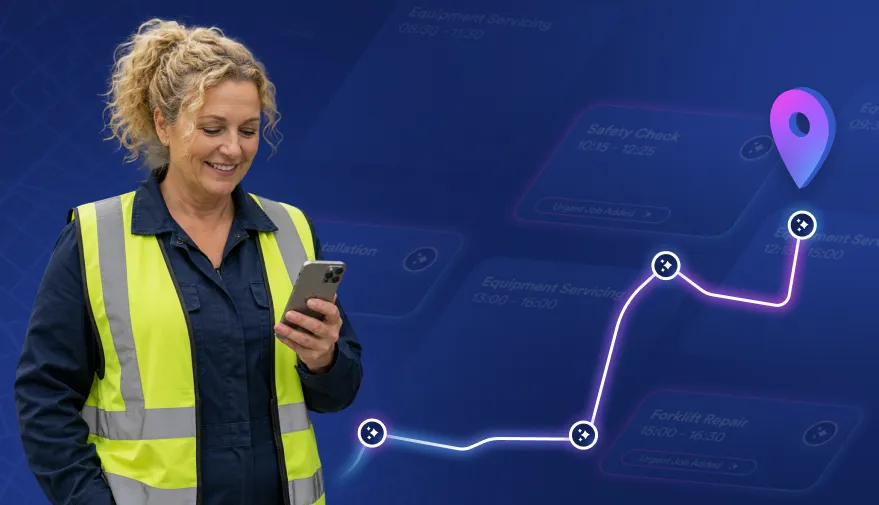
Real-Time AI Schedule Optimisation: Replanning Your Field Service Day Live


Why route optimisation needs to work during the day
No field service day ever runs to plan.
You build a tidy schedule the night before. By mid-morning, it's out of date. Urgent jobs land. Engineers overrun or finish early. Reactive work needs slotting in after engineers have left the depot.
When the day shifts, most teams reshuffle the hard way - phone calls, schedule edits, whiteboard juggling, all under SLA pressure. The result? Poorly sequenced routes, missed SLAs, and dispatchers firefighting instead of planning.
It's the same pattern across mid-large field service organisations: dispatchers losing hours every day to manual rebalancing instead of higher-value work.
Real-Time AI Schedule Optimisation tackles it head-on. It extends Service Geeni's existing AI Route Optimisation and AI Scheduling Agent into the live operational day - so your team can react in real time without losing the plot.
What is Real-Time AI Schedule Optimisation?
Real-Time AI Schedule Optimisation is a feature inside Service Geeni's field service management software that replans your engineer schedules during the live service day.
It uses live operational data - engineer locations, job statuses, remaining availability, and your existing scheduling rules - to generate an optimised plan for the rest of the day.
Your dispatcher reviews it. Your dispatcher decides. Nothing happens automatically - engineers in the field are protected by built-in safeguards.
How it differs from traditional route optimisation
Traditional route optimisation assumes your schedule is stable before the day begins. Plans are built overnight. Engineers start from a depot. The optimisation runs against tomorrow's tidy picture - and cracks the moment the day starts moving. Same-day optimisation makes three big changes:
- Routing origin - Routes start from each engineer's live position, not a theoretical depot.
- Replanning window - Only the remaining hours of the day get optimised.
- Operational safeguards - Started jobs and near-term work are excluded, so the optimiser only moves what can safely move.
The problems it solves
- Reactive jobs disrupt the plan. Finding the right engineer across 30 or 50 technicians takes time you don't have.
- Engineers go off-plan. A job runs over, the next one runs short, and the rest of the day is out of order.
- Depot routing isn't realistic mid-day. Your engineers aren't at the depot - and routing as if they are produces journeys nobody can actually do.
- Manual reshuffling is risky. Under pressure, it's easy to pull an engineer off work they've already started.
- Coordination eats your day. Phone calls and schedule edits swallow hours that should go on exception management.
How Real-Time AI Schedule Optimisation works
The workflow is deliberately simple.
- An operational change kicks in - a new urgent job, an availability change, an overrun, or a customer cancellation.
- The optimiser builds a proposed plan - using live engineer positions and every existing rule (locked jobs, working hours, site times, skills, availability).
- Your dispatcher reviews and decides - apply the plan or dismiss it.
- Protected work stays protected - started jobs, active engineer time, and anything inside the fire-break window are off-limits by default.
Operational safeguards: fire-break and started-job protection
Live replanning is only useful if your team can trust it. Two built-in safeguards make sure they can.
Fire-break protection
The fire-break window is a configurable buffer that stops the optimiser changing work too close to the current time. Set it to 120 minutes? No job in the next two hours can be moved. Simple as that.
You get three wins:
- Engineers already travelling don't get yanked off course
- Customer communication stays stable
- Your near-term schedule stays predictable
Most teams start between 90 and 120 minutes, then fine-tune.
Started-job protection
Any job already started on a mobile device is locked. The optimiser won't reassign, resequence, or move it. Same goes for active engineer time and unavailable periods. Your optimiser only ever works with slots that can realistically still change. No surprises.
Routing from where your engineers actually are
Here's one of the biggest changes: how routing origins get calculated.
Traditional optimisation routes from a depot. That works for tomorrow's plan, when engineers will genuinely start there. It doesn't work mid-day. By 11am, your team is scattered across the region - and routing a 2pm job from a depot they left four hours ago gives you a journey that looks neat on paper and falls apart in real life.
Same-day optimisation routes from each engineer's live GPS position - or their current job site. So you get:
- Travel time estimates that match reality
- Faster matching of nearby engineers to incoming reactive jobs
- Better fuel and mileage efficiency
- Quicker same-day response on urgent work
For organisations with serious travel distances - utilities, industrial maintenance, materials handling, GSE, medical equipment - this one change can be the difference between a workable same-day plan and a paper exercise.
Today plans vs Tomorrow plans
We keep same-day and next-day optimisation as two separate workflows. You toggle between them.
Today plans are built for live responsiveness:
- Live replanning from current engineer positions
- Optimisation limited to the remaining hours
- Fire-break and started-job protection always on
- No KPI savings comparisons (the baseline shifts all day, so the numbers would mislead you)
Tomorrow plans are built for strategic future-day optimisation:
- Full-day planning from depot start points
- Before-and-after visibility on mileage, fuel, time, and cost savings
- A stable baseline so you can measure impact
Tomorrow plans build your stable baseline. Today plans react when the day pushes back.
Your dispatchers stay in control
Operations teams are right to be wary of "black box" automation. Schedules changing on their own, with no oversight? Hard pass.
Real-Time AI Schedule Optimisation doesn't work that way. The optimiser proposes. Your dispatcher decides. Notifications surface when an opportunity exists, but no change is applied without review.
That means you can roll it out without rewriting dispatch processes - or asking your operations leaders to trust uncontrolled automation with SLA-critical work.
What you get out of it
- Less time spent on manual replanning
- Faster response to reactive jobs
- Better engineer utilisation across the live day
- More realistic routing
- More stable customer communication
- Protected active work - nothing in motion gets moved
- Hours back in your dispatchers' day
These are the levers that move first-time fix rates, SLA compliance, engineer utilisation, and customer satisfaction.
Who will benefit the most?
Real-time schedule optimisation delivers the biggest impact for businesses where the service day is fast-moving and difficult to predict. If any of the following sounds familiar, it's worth paying attention.
You manage a large field engineering team. The more engineers you have out on the road, the harder it becomes to manually rebalance schedules when something changes. Real-time optimisation scales with your operation, handling complexity that quickly becomes unmanageable by hand.
Your engineers cover a wide geographic region. Longer travel distances mean inefficient routing has a greater cost - in time, fuel, and capacity. Optimising from live engineer locations rather than a fixed depot start makes a measurable difference when your team is spread across a large area.
You deal with both planned and reactive work. Businesses that mix scheduled maintenance with reactive callouts face constant disruption to pre-built schedules. Real-time optimisation allows urgent jobs to be inserted into the active day without manually reshuffling everything around them.
Your dispatch team spends hours replanning manually. If coordinators are regularly on the phone reorganising engineer routes, that time has a cost. Replacing manual replanning with AI-assisted proposals frees your team to focus on exceptions rather than logistics.
You struggle to respond quickly to same-day changes. Delays, overruns, and last-minute jobs are unavoidable in field service. The businesses that benefit most from real-time optimisation are those currently absorbing that disruption through guesswork rather than structured decision-making.
Frequently asked questions
What is Real-Time AI Schedule Optimisation?
Real-Time AI Schedule Optimisation is a feature inside Service Geeni's field service management software that replans engineer schedules live during the service day. It uses each engineer's current location, job status, and remaining availability to propose an optimised plan for the rest of the day. Your dispatcher reviews and applies it - nothing changes automatically.
Why does same-day route optimisation matter?
Same-day route optimisation matters because real field service operations change throughout the day, and traditional route optimisation can't react once the schedule is live. Without it, your dispatchers reshuffle work manually under pressure - slow, risky, and exhausting.
Who is Real-Time AI Schedule Optimisation for?
Real-Time AI Schedule Optimisation is built for service managers, schedulers, dispatchers, and operations leaders in mid-large field service organisations. It's especially useful if you've got a large engineer team, significant daily travel, and a steady flow of reactive work.
What operational problems does it solve?
Real-Time AI Schedule Optimisation solves the gap between pre-planned optimisation and the reality of a live day. You replan less manually, react faster to reactive jobs, route from real engineer positions, and keep active work safe from disruption.
How does it compare to manual processes or legacy systems?
Real-Time AI Schedule Optimisation replaces manual replanning and extends legacy route optimisation into the live day. Manual processes rely on dispatcher experience, phone calls, and spreadsheet juggling. Legacy route optimisation only handles next-day planning. Same-day optimisation gives you intelligent, controlled live replanning with built-in safeguards.
By routing engineers from their live location rather than a fixed depot, the system cuts unnecessary mileage and reduces fuel costs across the whole team. Engineers spend less time travelling between jobs and more time on-site, improving daily output. When urgent or high-priority jobs come in, they can be inserted into the active schedule quickly - so your team reaches the jobs that matter most without disrupting everything else.
Does it improve first-time fix rates?
Yes, indirectly. Real-Time AI Schedule Optimisation makes it much easier to dynamically allocate the closest, most appropriate engineer to reactive work - and first-time fix depends on matching the right engineer to the right job with the right parts and skills. Better scheduling and dispatch quality is widely recognised as a primary driver of first-time fix performance.
How does it support compliance and reporting?
Real-Time AI Schedule Optimisation respects all your existing constraints - engineer skills, certifications, working hours, site opening times, and availability rules. Compliance stays intact during live replanning. Every schedule change is recorded in job history and feeds your standard service reporting.
Is it suitable for enterprise or multi-site organisations?
Yes. Real-Time AI Schedule Optimisation is designed for mid-large field service operations and works across multi-site, multi-region deployments. Existing route optimisation configuration is reused, so you can trial it without reconfiguring everything.
What industries benefit most from same-day route optimisation?
Same-day route optimisation benefits engineer-heavy operations with significant daily travel and reactive work. Strong-fit industries include engineering services, industrial maintenance, materials handling, GSE equipment, medical and catering equipment service, manufacturing maintenance, utilities, and logistics.
Can engineers use Real-Time AI Schedule Optimisation on mobile devices?
Engineers don't interact with the optimiser directly - they carry on using the Service Geeni mobile app to update job status, check in to sites, and complete digital work orders. That mobile data feeds the optimiser. Your dispatcher reviews proposed plans on the desktop dispatch interface.
Does Real-Time AI Schedule Optimisation replace dispatchers with AI?
No. Real-Time AI Schedule Optimisation is dispatcher-controlled - the optimiser proposes, your dispatcher decides. This is assisted operational replanning, not autonomous dispatch. AI takes the heavy lifting off route mathematics so your team can focus on the decisions that need a human.
How much configuration is required?
Hardly any. Real-Time AI Schedule Optimisation reuses your existing route optimisation configuration in Service Geeni. The only new setting is the configurable fire-break window in System Defaults.
Final thoughts
Your service day isn't static, and route optimisation that pretends otherwise will always come up short. The most valuable scheduling software works when the day is moving - not just the night before.
Real-Time AI Schedule Optimisation gives you a safe, controlled way to rebalance engineer schedules in real time. Less manual firefighting. Faster reactive response. More realistic routes. More hours back on the decisions that move your KPIs.
Want to see how it fits alongside AI Scheduling, the mobile engineer app, and work order management? Book a demo for an operational walkthrough.
Download Full PDF
Read More…
.png)
.webp)

Book Your Demo Today